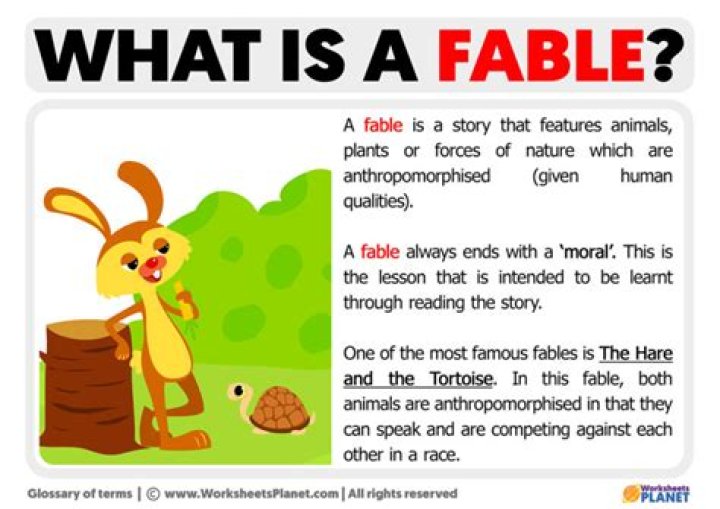
Aesop’s fables have long been used to teach children lessons about moral living. A fable is a form of story telling that usually features animals behaving like humans. The purpose of the fable is to teach a lesson about a human weakness or folly.
What is the main theme of the fable?
It is also a story about how even the weakest can out maneuver and manipulate those stronger through trickery. Almost all fables are written to provide a moral lesson to the reader. Usually written for children, they teach about life through the use of animals who symbolically represent human traits and flaws.
What is a fable and what is its purpose?
The Function of Fables The purpose of a fable is to convey moral messages to the readers. By using animals as the voices of reason in these stories, they are particularly appealing to young children who are learning how to behave morally in the world.
What are 4 characteristics of a fable?
Fables are defined by four central essential elements.
- Symbolism. Characters in fables are stand-ins for humans, and their misadventures are meant to symbolize human behavior.
- Anthropomorphization.
- Lessons.
- Humor.
What lessons of life do we learn from wind?
The moral lessons that we learn from the poem is that the poem inspires us to face challenges and hardship with courage, firm determination and grit. The poem Wind is a symbol of problems and obstacles which are to be dealt with without fear.
What lesson do we learn from the poem answer?
Although we commit mistakes and face failures, there is always a hope for a next chance in our lives. We must have a strong desire to try and make our life and our world better.
What are the 10 values?
10 Values Every Man Must Have
- Courage. People usually mistake courage for boldness.
- Humility. Humility is one of the most talked values among people.
- Kindness.
- Self-Confidence.
- Tender Aggression.
- Focus.
- Honesty.
- Self-respect.